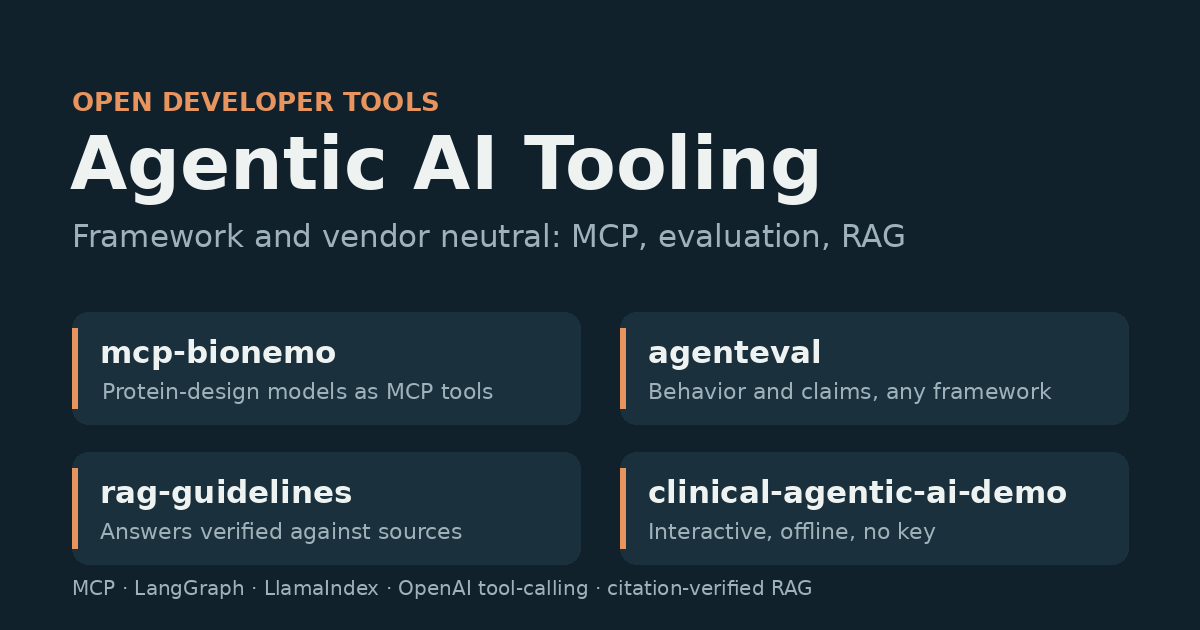
These tools address recurring integration and evaluation problems I encountered while building agents. They support selected models, APIs and trace formats, with explicit offline examples and documented limits.
mcp-bionemo: a typed integration boundary
Motivation: An agent using scientific models needs a clear contract for each tool’s inputs, outputs and errors. Connecting every client directly to endpoint-specific HTTP calls also makes integration difficult to test without credentials or model access.
What the program does: mcp-bionemo exposes selected protein-design model operations (RFdiffusion, ProteinMPNN, Boltz-2) as typed Model Context Protocol (MCP) tools. An MCP client can discover the tools, submit structured requests and receive results through one interface. A deterministic simulator supports offline integration tests, while an optional live backend routes calls to configured hosted endpoints. The project focuses on the integration boundary, not scientific validation.
mcp-bionemo exposes selected model calls through typed MCP tools and an offline simulator. Its focus is a lightweight interface developers can inspect and test; it is one of several possible integration routes.
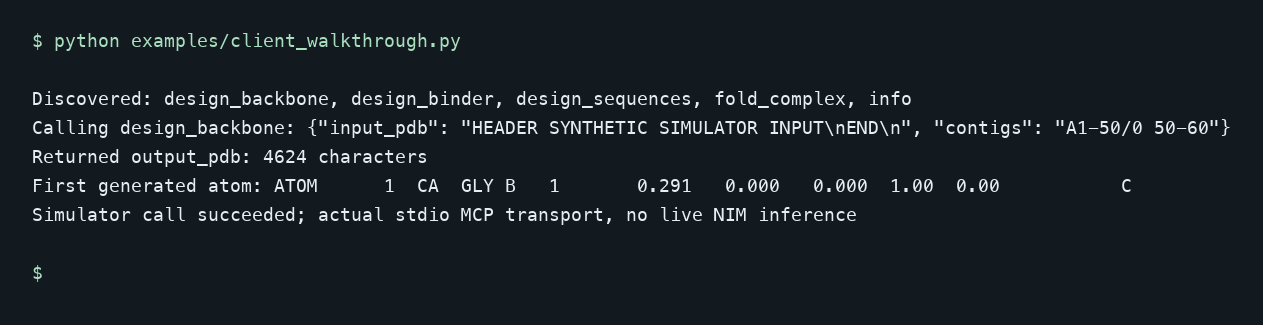
Example scope: Actual local MCP discovery and design_backbone invocation against the simulator. This does not validate live model endpoints.
Install pip install -e ".[dev]" and run pytest -q for simulator and mocked-client tests. The repository includes a stdio MCP-client walkthrough. Set BIONEMO_BACKEND=live only when you have endpoint access, credentials and scientifically appropriate inputs. The simulator exercises integration logic and produces meaningless scientific scores.
agenteval: metrics with explicit definitions
Motivation: A plausible final answer does not reveal whether an agent used unnecessary tools, repeated a loop or cited evidence that was never retrieved. Traces from different frameworks also need consistent interpretation before their scores can be compared.
What the program does: agenteval converts supported agent traces into a common representation and produces scorecards for tool use, loops and supplied task outcomes. A separate claims workflow screens citation IDs and numerical consistency against supplied evidence and reports confidence metrics when labels are available. It helps developers inspect failures and compare runs under explicit metric definitions; the scores do not establish semantic or domain correctness.
agenteval normalizes selected OpenAI-style, LangGraph and LlamaIndex traces. Assistant tool requests and responses are reconciled into one logical call before calculating success and loop metrics. Exact tool-set accuracy and call precision penalize unnecessary tools; expected-tool coverage remains a separate metric.
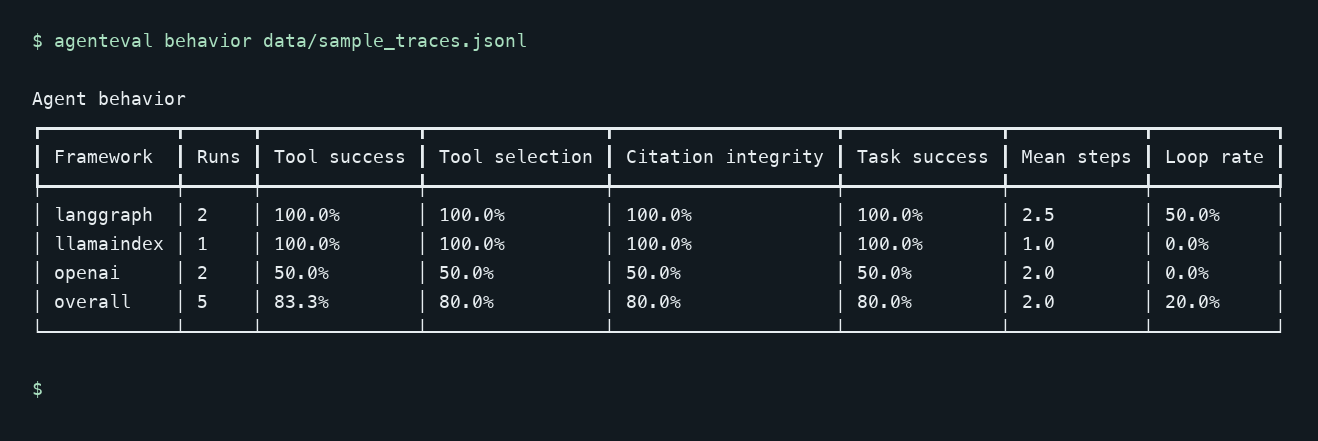
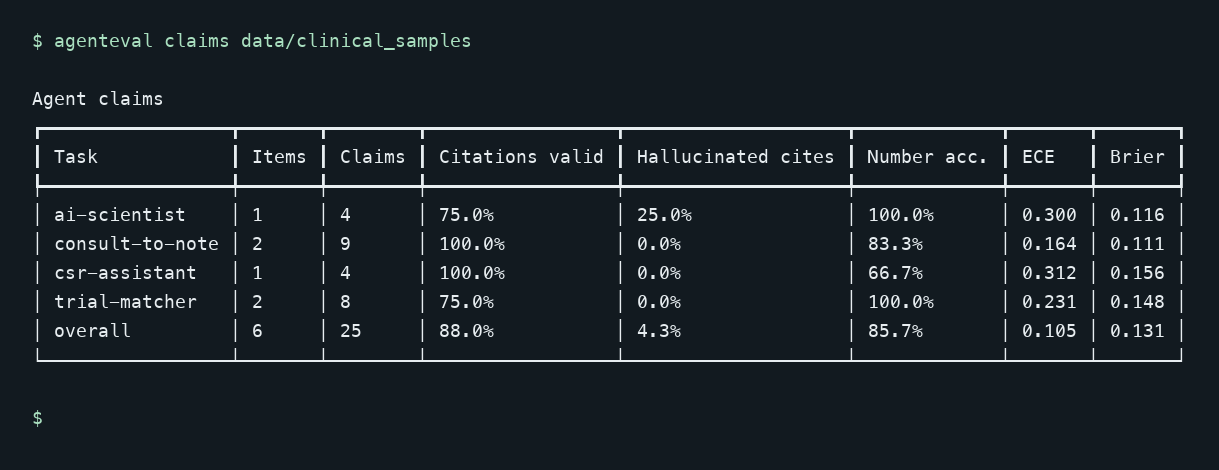
Example scope: Current CLI scoring of bundled traces and claim labels. Scores describe these fixtures, not model quality in production.
Install pip install -e ".[dev]", run pytest -q, then inspect agenteval --help for the sample trace and claim workflows.
Citation integrity checks whether cited IDs exist in the retrieved set. Numerical screening checks values against supplied evidence. These metrics do not prove semantic grounding; the legacy grounding_rate output is a compatibility alias for citation integrity. Expert-labelled outcomes and calibration studies require a suitable dataset.
rag-guidelines: inspectable retrieval checks
Motivation: Retrieving the right passage does not guarantee that an answer uses it correctly. A response can cite a real source while giving an unsupported number or reversing its meaning.
What the program does: rag-guidelines retrieves passages from a small corpus, produces an answer with sentence-level citations, and screens the answer for missing citation IDs, numerical mismatches and selected lexical or polarity inconsistencies. Its offline mode extracts text from a synthetic corpus; an optional backend generates answers through a configured model endpoint. The project makes retrieval and evidence checks visible for inspection.
rag-guidelines demonstrates retrieval over a small guideline corpus and sentence-level citation, lexical, polarity and numerical screening. Every cited ID must exist; one valid citation cannot hide an invalid one.
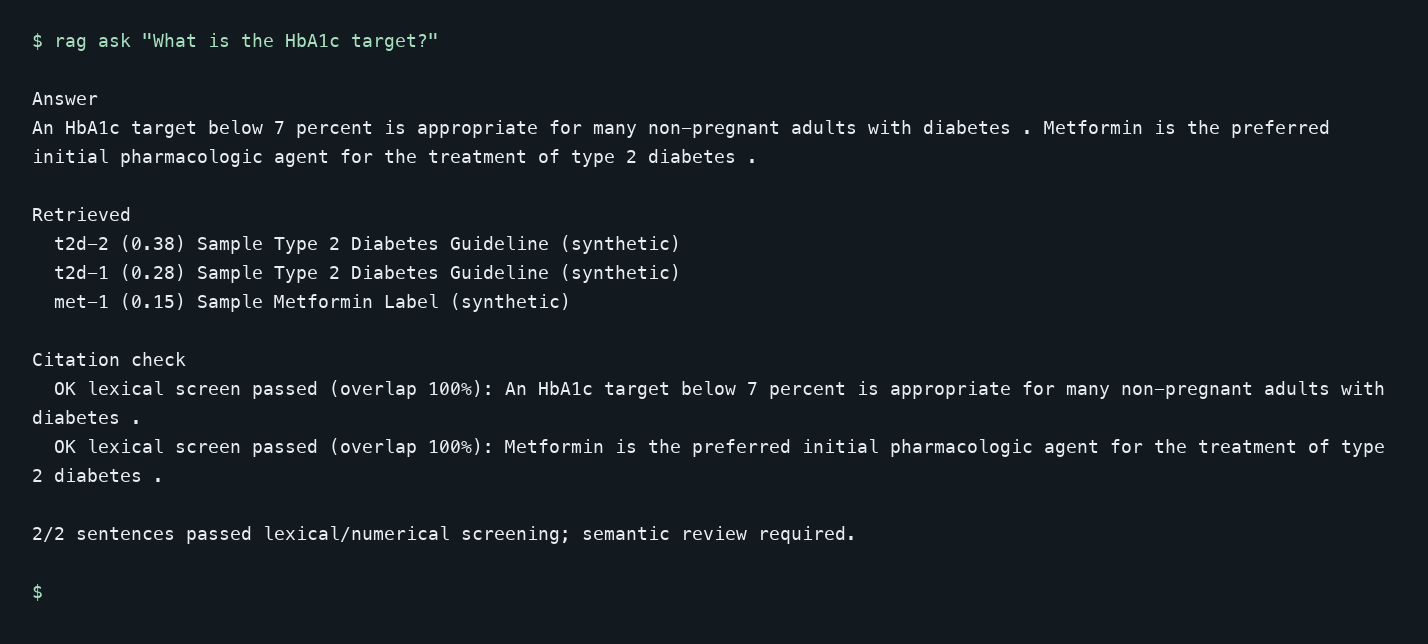
Example scope: Synthetic extractive lexical screening with bundled guideline excerpts. This is not a live clinical LLM evaluation.
Install pip install -e ".[dev]", run pytest -q, then try rag ask "What is the HbA1c target?". The default answer generator is offline and extractive; a live model backend is optional.
Word overlap and matching numbers are useful screening signals, not evidence of clinical entailment. Review the source passages and consult the repository’s limitations before adapting the example.
Learn by changing a trace
The 40-minute evaluation workshop includes an offline installation path, a trace-mutation exercise, automated checks and troubleshooting. It shows how a useful score can still leave semantic correctness unresolved.